
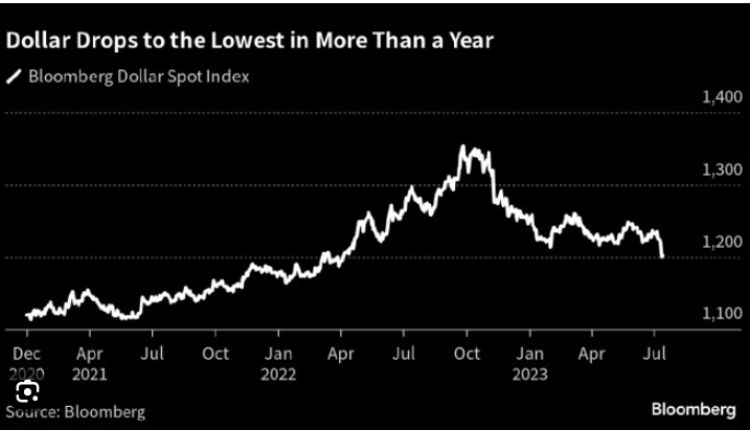
Introduction:
The USD Index, also known as the U.S. Dollar Index or DXY, is a widely watched financial benchmark that measures the performance of the United States dollar against a basket of major international currencies. This index plays a crucial role in the global financial landscape, affecting various aspects of economies and investments worldwide. In this article, we will delve into the intricacies of the USD Index, exploring its composition, key influencers, and the implications it holds for the global economy.
Understanding The USD Index:
The USD Index was introduced in 1973 by the Intercontinental Exchange (ICE) as a way to gauge the relative strength of the U.S. dollar against its major trading partners’ currencies. Initially set at 100.000, the index is now calculated based on a weighted geometric mean of six major currencies: the Euro (EUR), Japanese Yen (JPY), British Pound Sterling (GBP), Canadian Dollar (CAD), Swedish Krona (SEK), and Swiss Franc (CHF). These currencies represent significant trading partners of the United States, reflecting the USD’s performance in international trade.
Key Influencers Of The USD Index:
- Federal Reserve Monetary Policy: The actions and statements of the U.S. Federal Reserve significantly impact the USD Index. Decisions regarding interest rates, monetary easing, or tightening can lead to fluctuations in the index. For instance, higher interest rates typically strengthen the USD, increasing the USD Index value.
- Economic Indicators: The USD Index is sensitive to various economic indicators, such as Gross Domestic Product (GDP) growth, employment data, inflation rates, and consumer sentiment. Positive economic data can strengthen the USD and boost the index.
- Geopolitical Factors: Geopolitical events, such as trade tensions, political instability, and global conflicts, can influence investor sentiment and lead to fluctuations in the USD Index.
- Safe-Haven Demand: During times of market uncertainty, the U.S. dollar often serves as a safe-haven currency, leading to increased demand and strengthening the USD Index.
Implications Of The USD Index:
- Trade and Investment: The USD Index plays a vital role in international trade and investment decisions. A stronger USD can make U.S. exports more expensive for foreign buyers, potentially impacting U.S. businesses reliant on exports. On the other hand, a weaker USD can make U.S. goods more attractive to foreign buyers.
- Global Financial Markets: The USD Index influences not only currency markets but also various asset classes, including stocks, bonds, and commodities. Changes in the USD Index can affect investment strategies and portfolio diversification.
- Monetary Policies of Other Countries: Central banks of other nations often take the USD Index into account when formulating their monetary policies. Large fluctuations in the index may prompt responses from other central banks to stabilize their own currencies.
Conclusion:
The USD Index serves as a vital indicator of the U.S. dollar’s strength and its position in the global economy. It is influenced by a complex interplay of factors, including Federal Reserve policy, economic indicators, geopolitical events, and safe-haven demand. As investors, governments, and businesses closely monitor the USD Index, understanding its dynamics becomes crucial for making informed decisions in the ever-changing global financial landscape.
FAQs:
- What is the historical performance of the USD Index? The historical performance of the USD Index has seen fluctuations over the decades. It experienced significant volatility during economic crises, such as the 2008 global financial crisis and the COVID-19 pandemic. Additionally, changes in monetary policy and geopolitical events have contributed to fluctuations in the index over time.
- How can I use the USD Index to inform my investment decisions? Investors can use the USD Index as a tool to analyze the relative strength of the U.S. dollar and its potential impact on different asset classes. A stronger USD may influence strategies like hedging against currency risks, while a weaker USD could favor international investments for U.S. investors.
